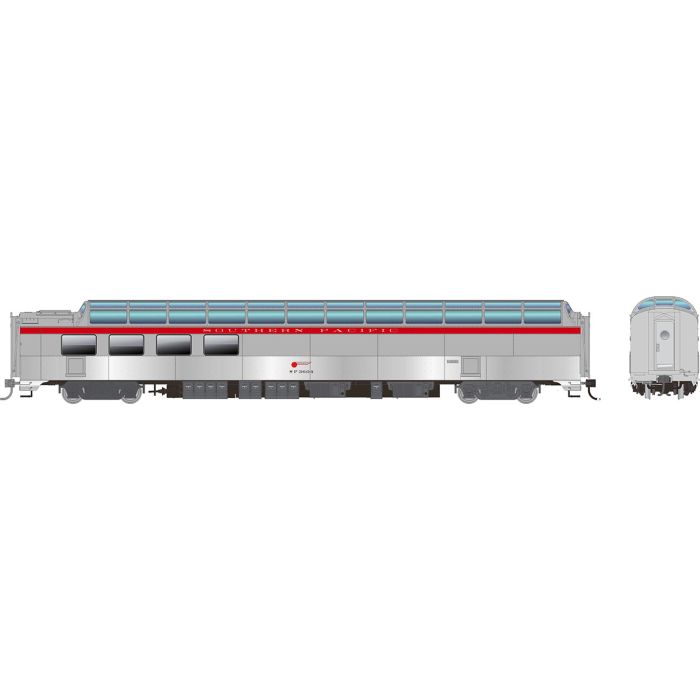
Rapido (175009) SP Dome-Lounge w/ Flat Sides | Southern Pacific General Service #3603 | HO Scale
Rapido (175009) SP Dome-Lounge w/ Flat Sides | Southern Pacific General Service #3603 | HO Scale
______________________________________________________________
💳 More flexible payment options available
This is a pre-order item!
On the product page, you must wait until the "Pre Order Now" and the "Partial Payment of $0.00" appear BEFORE you click "Pre Order Now". Otherwise, you will be charged full price up-front.
If you are ordering a pre-order item, please place a separate order for each type of product, otherwise the pay later option will not work.
Read about our refund policy and other policies including pre-order policies.
Rapido’s SP Dome Lounge Cars Features:
- Designed from original blueprints and field measurements of existing cars
- Two fully detailed interior configurations
- Multi-colour interior decoration
- Two underbody arrangements
- Accurate interior and exterior paint and decoration
- Full flicker-free track-powered interior lighting
- Lighting (prototypically) in the dome roof
- Accurate free-rolling trucks
- Metal magnetic knuckle couplers
SP built one prototype and six production Dome Lounge cars between 1954 and 1955. All were built new in the railroad’s Sacramento General Shops, using select frame pieces from various retired Pullman-Standard pre-war “Daylight” cars. The Budd Company supplied the dome structure as a kit. Essentially, these cars were new construction using salvaged frame pieces for accounting purposes. Another reason for using retired cars was that SP’s foundry couldn’t roll a long enough center sill and no one could supply one quickly enough.
Pressed into service on the San Joaquin and Shasta Daylights and the Overland and later in the 60s on the consolidated City of San Francisco and the Coast Daylight. Built with fluted side panels, the cars were modified by the SP with slab sides in the 1960s with some of the fleet later operating for Amtrak on a variety of routes through the 1970s.
These cars were introduced into service on the San Joaquin and Shasta Daylights and the Overland, but they later saw wider service. Originally built with fluted side panels, the cars were modified by the SP with slab sides in the 1960s. At least four of these cars lasted into the Amtrak era.
The interiors of the cars featured a bar/lounge on the lower level and one of two different configurations of seating on the upper level. In part because of the varied origins of the donor cars, underbody configurations also changed.
Rapido’s development crew includes a team of firsthand SP Dome Lounge experts, authors, and an actual car owner, providing hands-on research and deep personal experience with the cars since new. The model has been fully designed and includes two different interiors, two underbody arrangements, and either fluted or stepped flat sides!
All six 1955 Dome Lounge cars had an identical lower lounge with an eleven-foot ceiling height, which SP ad copy called “Pleasant Under Glass.”
On the first four cars, the Bar Lounge booth and banquette cocktail seating plan continued upstairs to the Terrace for about quarter of its length. From there forward, rows of two-person seats along a depressed aisle were canted slightly outward for best sightseeing. Cars of this floor plan were meant only for operation in a train consist with this upper level facing forward.
The last two cars were built for the Shasta Daylight, and eliminated the sightseer paired seating for additional cocktail lounge space, extending the banquette and booth seating to the entire upper Terrace Deck. Because this seating was non-directional, these two cars could operate in either direction in a train.
SP used the center sills and salvaged body framing from retired prewar ‘Daylight’ cars as a basis for its new Dome Lounge cars, so underbody equipment layout also varied as dictated by the location of crossmembers that were salvaged from the donor frames. Most notably the Waukesha propane bottle carriers — those distinctive boxes with ‘sow belly’ doors — were grouped more tightly in a long single row on the ‘Shasta’ pair, for greater ease in servicing the propane cylinders.
Couldn't load pickup availability